
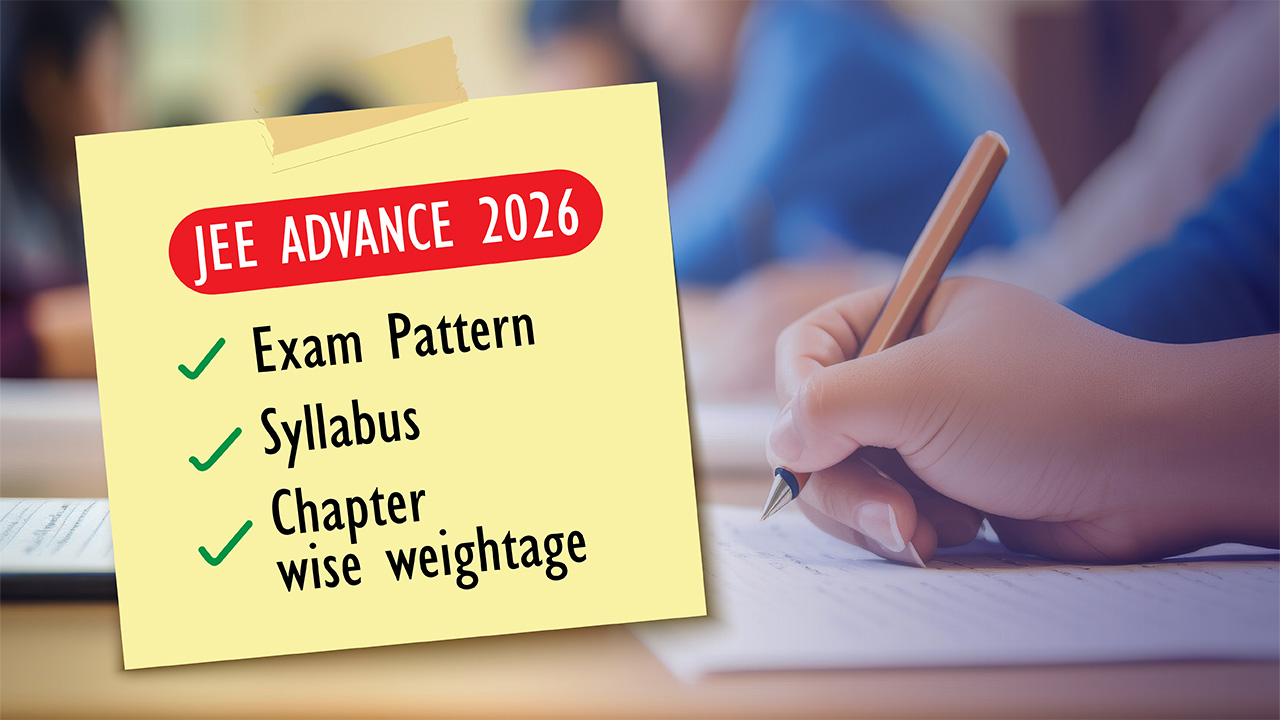
Complete Guide to 2026 Exam Pattern and Syllabus: Chapter-wise Weightage for Competitive Exams
Understanding the 2026 Exam Pattern and Syllabus
The competitive exam consists of two compulsory papers, Paper 1 and Paper 2, each designed to test candidates' comprehension, reasoning, and analytical ability. For students seeking admission to premier institutions, understanding the exam pattern and syllabus is crucial for success.
Key Features of the Exam Pattern:
- Mode: Computer-Based Test (CBT)
- Number of Papers: Two (Paper 1 and Paper 2)
- Duration: 3 hours per paper
- Subjects: Physics, Chemistry, and Mathematics
Question Types in the Exam:
- Multiple-Choice Questions (MCQs)
- Numerical-Based Questions
- Match the Following
Marking Scheme:
The exam follows a comprehensive marking system with full, partial, and negative marking. Specific details are disclosed in the instructions of each question. Students preparing at the best junior colleges for entrance exam coaching in Hyderabad receive detailed guidance on tackling the marking scheme effectively.
Detailed Exam Syllabus for Competitive Exams
Physics Syllabus
Understanding the physics syllabus is essential for mastering the 2026 exam pattern and syllabus. The topics include:
- General Physics: Dimensional analysis, error analysis, vectors
- Mechanics: Kinematics, laws of motion, work-energy theorem, circular motion, rotation, gravitation
- Thermodynamics: Laws of thermodynamics, kinetic theory of gases, heat transfer
- Electricity and Magnetism: Electrostatics, current electricity, magnetic effects of current, electromagnetic induction
- Optics: Wave optics, reflection, refraction, interference, diffraction
- Modern Physics: Photoelectric effect, atomic structure, nuclear physics
Chemistry Syllabus
The chemistry section is divided into three major areas:
Physical Chemistry:
- Mole concept, stoichiometry, atomic structure
- Thermodynamics, equilibrium, electrochemistry, kinetics
Inorganic Chemistry:
- Periodic table, chemical bonding, coordination compounds
- Hydrogen, s-, p-, d-, and f-block elements
Organic Chemistry:
- Hydrocarbons, alcohols, aldehydes, ketones
- Biomolecules, polymers, aromatic compounds
- General organic chemistry mechanisms and stereochemistry
Mathematics Syllabus
Mathematics forms a critical component of competitive exams:
- Algebra: Quadratic equations, sequences, series, complex numbers, matrices, and determinants
- Calculus: Limits, continuity, differentiability, integration, differential equations
- Trigonometry: Identities, equations, inverse trigonometric functions
- Coordinate Geometry: Straight lines, circles, parabolas, ellipses, and hyperbolas
- Vectors and 3D Geometry: Vector operations, scalar triple product, direction cosines
- Probability and Statistics: Mean, variance, probability theorems
Chapter-wise Weightage for Competitive Exams
Understanding the chapter-wise weightage for competitive exams helps students prioritize their preparation strategy. The best junior colleges for entrance exam coaching in Hyderabad use this data to create focused study plans.
Physics - Chapter-wise Weightage
Chapter | Approximate Weightage (%) |
Mechanics | 20% |
Electrodynamics | 18% |
Thermodynamics | 10% |
Optics | 10% |
Modern Physics | 12% |
Waves and Oscillations | 8% |
Chemistry - Chapter-wise Weightage
Chapter | Approximate Weightage (%) |
Physical Chemistry | 35% |
Organic Chemistry | 30% |
Inorganic Chemistry | 35% |
Mathematics - Chapter-wise Weightage
Chapter | Approximate Weightage (%) |
Algebra | 25% |
Calculus | 30% |
Coordinate Geometry | 20% |
Trigonometry | 10% |
Vectors and 3D Geometry | 15% |
Preparing for the 2026 Exam Pattern and Syllabus
Success in competitive exams requires strategic preparation based on the chapter-wise weightage for competitive exams. Students enrolled in the best junior colleges for entrance exam coaching in Hyderabad benefit from:
- Expert faculty guidance on the complete syllabus
- Regular practice with the latest exam pattern
- Focused attention on high-weightage chapters
- Comprehensive study materials aligned with the 2026 exam pattern and syllabus
- Mock tests simulating actual exam conditions
Tips for Effective Preparation:
- Focus on high-weightage topics like Mechanics (20%), Calculus (30%), and Physical Chemistry (35%)
- Practice numerical-based questions regularly
- Understand the marking scheme to minimize negative marking
- Take regular mock tests following the 2026 exam pattern
- Seek guidance from experienced faculty at reputed coaching centres
Why Choose the Best Junior Colleges for Entrance Exam Coaching in Hyderabad?
Hyderabad is home to several premier institutions offering specialized entrance exam coaching. The best junior colleges for entrance exam coaching in Hyderabad provide:
- Comprehensive coverage of the 2026 exam pattern and syllabus
- Detailed analysis of chapter-wise weightage for competitive exams
- Experienced faculty with proven track records
- State-of-the-art infrastructure and learning resources
- Regular assessments and personalized feedback
- Peer learning environment with motivated students
By understanding the complete exam pattern, syllabus, and chapter-wise weightage for competitive exams, students can develop an effective preparation strategy. Choosing the right institution among the best junior colleges for entrance exam coaching in Hyderabad can significantly enhance your chances of success in competitive examinations.
Start your journey to success by mastering the 2026 exam pattern and syllabus today!
